
What Are Cabochon Lights? The Complete Guide to Amusement Pixel Bulbs
- date: 2026-08-18
- category: Industry knowledge
- click:
"Cabochon lights" is a term that confuses many people outside the fairground and carnival industry — yet for ride operators, showmen, and amusement park managers, they are as fundamental as the rides themselves. This complete guide explains exactly what cabochon lights are, where the term comes from, how they work, and how to choose the right ones.
The Origin of the Word "Cabochon
In jewelry, a "cabochon" (pronounced kab-oh-shon, from the French word for "head") describes a gemstone that has been shaped and polished into a smooth, convex dome rather than faceted into flat planes. Cabochon-cut stones include moonstones, opals, and some rubies.
The name was applied to fairground light bulbs because the early decorative bulbs used on carousels and funfair rides had the same characteristic shape: a smooth, rounded dome covering the light source. The resemblance to a gemstone — small, colorful, and sparkling — made the name stick, and it has been the standard term in the British fairground industry for over 60 years.
|
|
What Is a Cabochon Light, Technically?
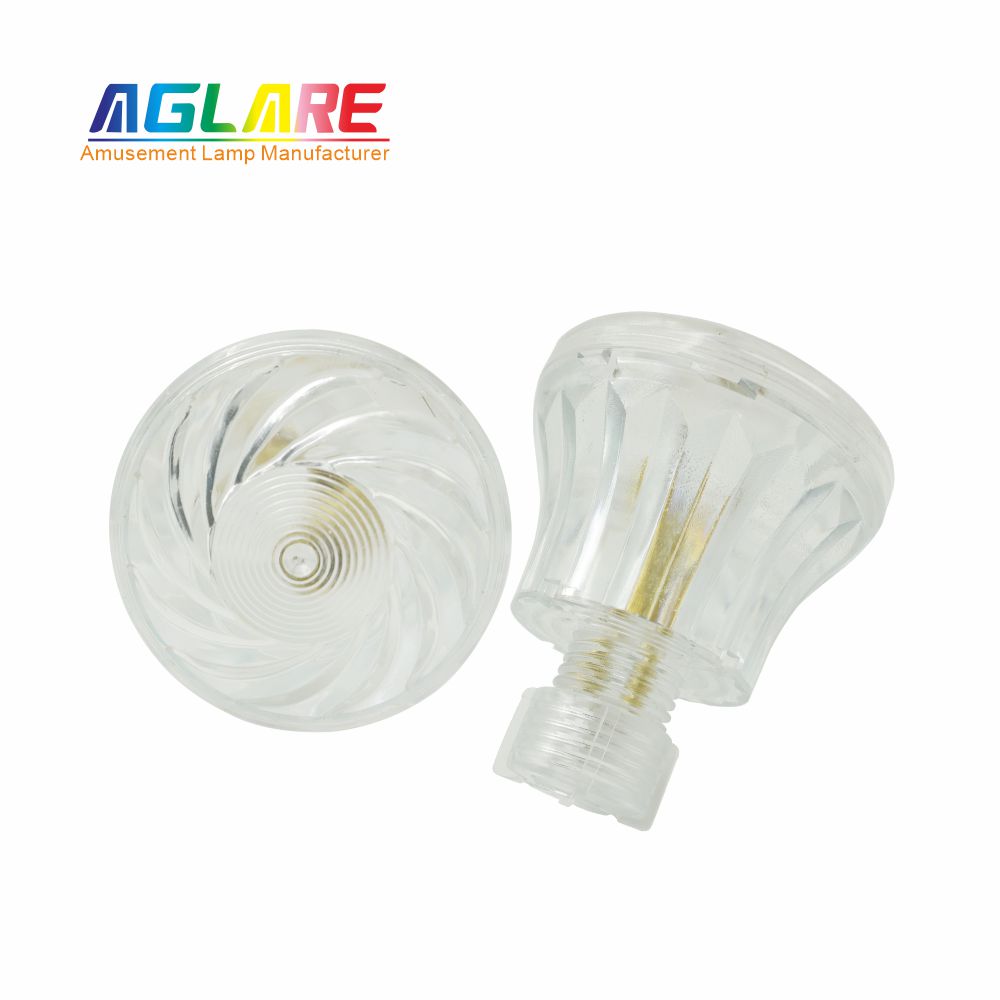
A cabochon light (in the modern LED context) is a small-format LED light source in a dome-shaped housing with an Edison screw base (E10 or E14), designed for installation in large arrays on fairground rides and carnival attractions.
The key components:
⦿ Dome/lens: Polycarbonate or PMMA (acrylic) dome that diffuses and shapes the light output. The dome protects the electronics from weather and provides the characteristic visual appearance.
⦿ LED chip array: Red, green, and blue LED chips (RGB) that mix to produce any visible color
⦿ IC chip: Integrated circuit that controls the color sequence and animation pattern
⦿ PCB (circuit board): Connects the LED chips, IC, and voltage regulation components
⦿ Base: E10 or E14 Edison screw base for installation in standard ride sockets
⦿ Sealing: Silicone or epoxy potting to achieve the IP65/IP67 waterproof rating
How Cabochon Lights Create Color-Chasing Effects
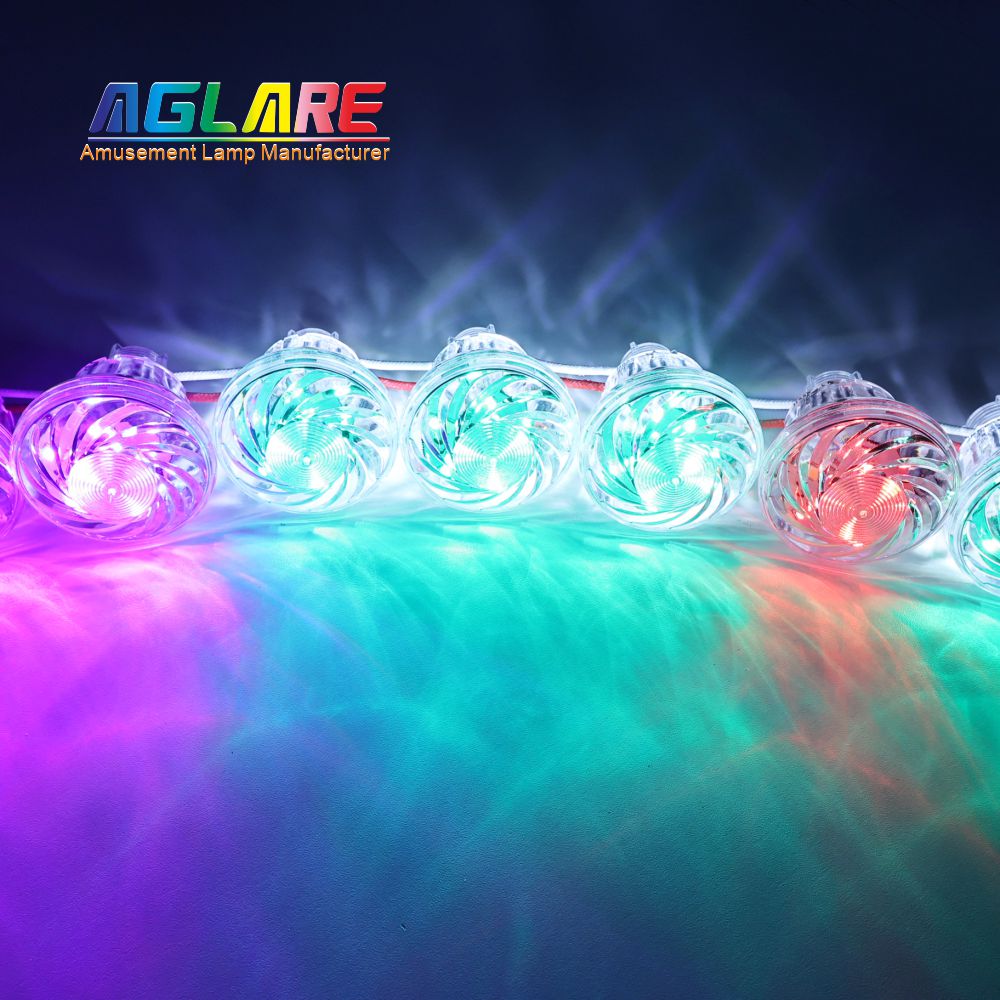
A single cabochon light simply displays whatever color its IC program dictates at any given moment. The dramatic chasing and color-wave effects seen on fairground rides come from the combination of many cabochon lights running slightly offset programs:
Example: Installing 8 cabochon lights in positions 1 through 8 around a carousel horse, each with a different program number (program 1, 2, 3, 4, 5, 6, 7, 8), means each light is at a different stage of the same color sequence at any given moment. From a distance, the colors appear to "chase" around the horse in sequence.
Scale this to 500 bulbs on a complete carousel with carefully planned program sequencing, and the result is the signature rippling, chasing light effect that defines the modern fairground aesthetic.
The Evolution from Incandescent to LED Cabochon
The earliest fairground cabochon lights were simply incandescent bulbs with colored glass or plastic dome covers. They were:
⦿ Fixed color (the dome color)
⦿ High energy consumption (5W–15W per bulb)
⦿ Short-lived (500–1,500 hours)
⦿ Hot to the touch (fire risk in some configurations)
The transition to LED cabochon lights (which began in earnest around 2010 and accelerated dramatically from 2015 onwards) delivered:
⦿ RGB color mixing — any color from one bulb type
⦿ Dynamic color changing via IC programs
⦿ 95% energy reduction
⦿ 20x longer lifespan
⦿ Cool operating temperature
6th Generation LED Cabochon: What's Different
The current state-of-the-art for LED cabochon lights is the 6th generation, which introduces:
COB Flip-Chip construction: The LED chip is bonded without a wire, eliminating the primary failure mode (wire bond corrosion) for outdoor applications.
16 built-in programs: More program variety allows more complex chasing effects without DMX control.
True multi-voltage: AC24V / DC24V / DC12V from a single product, simplifying inventory management.
Enhanced IP67 sealing: Full submersion protection, tested to IEC 60529 standard.
Common Questions About Cabochon Lights
Are cabochon lights the same as pixel lights? Yes and no. "Cabochon" and "pixel light" describe the same category of product — LED amusement ride bulbs with IC chips. "Cabochon" is the older, traditional British fairground term; "pixel light" is the more recent LED-era terminology. Both refer to the same type of product.
Can I mix different program numbers on the same circuit? Yes. Different program numbers on the same power circuit is standard practice for creating chasing effects. The program number only affects the IC timing, not the electrical compatibility.
Do I need a controller for cabochon lights? For auto-program cabochon lights: No controller needed. The IC chip runs the program independently. For DMX cabochon lights: Yes, a DMX controller is required.