
2026 Guide to Wiring Amusement Park Light Bulbs: AC24V vs DC24V Explained
- date: 2026-09-02
- category: Industry knowledge
- click:
When it comes to setting up lighting for amusement park rides, one of the most common points of confusion is the electrical supply voltage. Should you use AC24V or DC24V? What does it mean for your bulbs, controllers, and overall safety? This guide breaks down everything ride operators and procurement teams need to know before wiring amusement park light bulbs in 2026.
 |  |
Why Voltage Choice Matters for Amusement Ride Lighting
The voltage you choose affects three key factors: bulb lifespan, controller compatibility, and safety compliance. Using the wrong voltage can instantly damage LED pixel bulbs or, worse, create a fire hazard on a busy fairground. Understanding the difference between AC (alternating current) and DC (direct current) at 24 volts is the first step toward a safe, long-lasting lighting installation.
AC24V vs DC24V: The Core Differences
What Is AC24V?
AC24V stands for alternating current at 24 volts. It is derived from the mains supply through a step-down transformer. In Europe and many Asian markets, the standard mains voltage is 220-240V AC, stepped down to 24V AC for ride lighting circuits.
Advantages of AC24V:
Simpler transformer-based power supply (lower cost)
Well-suited to long cable runs with minimal voltage drop
Compatible with the widest range of traditional fairground bulb sockets (E10, E14)
Standard in European and Asian carnival ride manufacturing
Disadvantages of AC24V:
Requires AC-to-DC conversion if using modern LED pixel controllers
Polarity does not matter, but it cannot directly power DC-only LED modules
What Is DC24V?
DC24V stands for direct current at 24 volts. It is produced by a switching power supply (SMPS) from the mains input. DC power is used extensively in modern LED pixel lights and programmable lighting systems.
Advantages of DC24V:
Compatible with all modern RGB LED pixel lights and DMX512 controllers
Stable, smooth power output with no flickering
More efficient for LED driver circuitry
Required for programmable auto-running pixel light systems (1-16 channel programs)
Disadvantages of DC24V:
Switching power supplies add cost
Longer cable runs can suffer greater voltage drop; cable sizing is critical
DC12V: A Third Option
Some ride manufacturers use DC12V, particularly for smaller rides and kiddie attractions. DC12V is common for E10 base bulbs on carousels and smaller fairground rides. The lower voltage means even greater safety for technicians, but it also means higher current draw for the same wattage, requiring heavier-gauge wiring.
Step-by-Step Wiring Guide for Amusement Park Light Bulbs
Step 1: Identify the Ride Manufacturer's Specification
Before purchasing any bulbs or power supplies, check the ride's original electrical schematic. Most European rides (Zierer, Huss, Chance Rides) specify AC24V. Many Chinese-manufactured rides use DC12V or DC24V.
Step 2: Calculate Total Load
Count the total number of bulb sockets on the ride. Multiply by the wattage of each bulb:
Standard E14 cabochon LED: 0.5W–1W per bulb
RGB pixel light (with built-in IC): 0.3W–0.5W per bulb
Turbo lamp (larger format): 3W–5W per bulb
Example: 500 × E14 LED cabochon at 0.5W = 250W total load. Use a 300W transformer or power supply for 20% safety headroom.
Step 3: Size Your Cables
For AC24V systems, voltage drop is less critical because transformers can be distributed. For DC24V/DC12V systems:
Use minimum 1.5mm² copper cable for runs up to 5 meters
Use 2.5mm² for runs up to 15 meters
Use 4mm² for runs beyond 15 meters
Step 4: Install Fusing on Each Circuit
Each branch circuit should be fused individually. A blown fuse on one section of the ride should not take down the entire lighting system. Use automotive-style blade fuses (5A–15A depending on load) for easy field replacement.
Step 5: Test Before Final Assembly
Always power up the circuit with bulbs installed before the ride is fully assembled. Check for:
Correct color sequence on programmable pixel lights
No flickering or dimming on any section
All controller functions (speed, color, mode) operating correctly
Step 6: Weatherproofing All Connections
All outdoor connections must be IP65 rated minimum. Use IP67 gel-filled connectors for connections exposed to rain or high-pressure washing during maintenance. Aglare's LED pixel lights use a sealed, pre-potted construction that eliminates the need for additional weatherproofing on the bulb itself.
Common Wiring Mistakes to Avoid
| Mistake | Consequence | Solution |
| Mixing AC and DC systems | Immediate bulb failure | Always verify supply type before installation |
| Undersized cables | Voltage drop, dim bulbs, overheating | Follow cable sizing table above |
| No individual fusing | One fault kills entire ride lighting | Fuse every 10-15 bulb section separately |
| Non-IP rated connectors | Water ingress, shorts, safety hazard | Use IP67 gel connectors for all outdoor joins |
| Incorrect polarity on DC systems | Bulbs do not light; controller damage | Mark positive/negative clearly during installation |
Choosing the Right Amusement Park LED Bulbs for Your Voltage
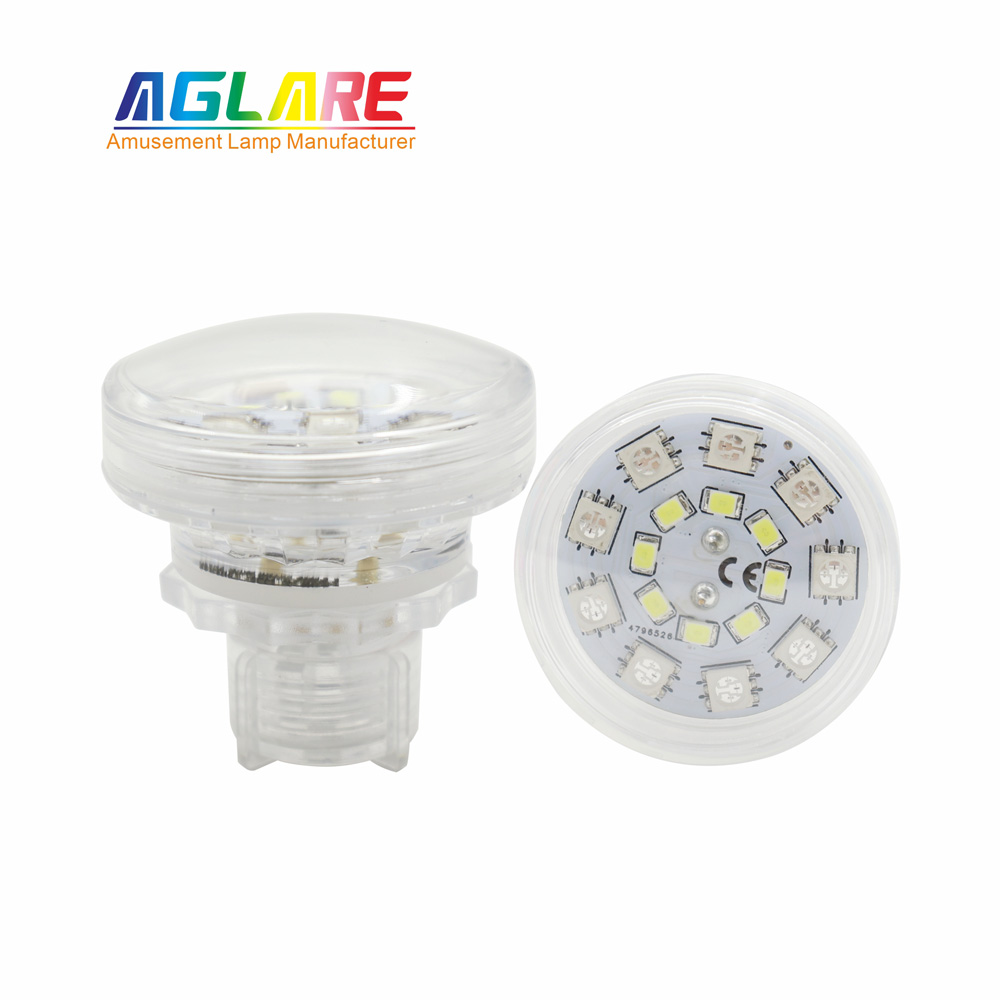
Aglare manufactures amusement park LED pixel lights and E10/E14 cabochon bulbs compatible with all three voltage systems: AC24V, DC24V, and DC12V. The 6th-generation pixel lights feature a built-in IC chip with 16 auto-running color programs, eliminating the need for an external controller in simple installations.
For complex rides requiring synchronised color effects across hundreds of lights, the DMX512-compatible version allows full programming via a DMX console.
Frequently Asked Questions
Can I mix AC24V and DC24V bulbs on the same ride? No. Mixing voltage systems will damage bulbs and potentially create a safety hazard. Always use a single voltage standard throughout one ride circuit.
Do LED amusement bulbs get hot enough to cause burns? LED amusement bulbs run significantly cooler than traditional incandescent fairground bulbs. Surface temperatures rarely exceed 40-50°C, making them far safer for family attractions.
How long do LED amusement bulbs last vs incandescent? LED: 30,000–50,000 hours. Incandescent: 1,000–2,000 hours. The LED upgrade pays for itself within one season in most commercial operations.